Why the Middle Class Must Rethink Government Jobs (2025–2055)
 The OD Team Main Writer & Editorial Team 25 min read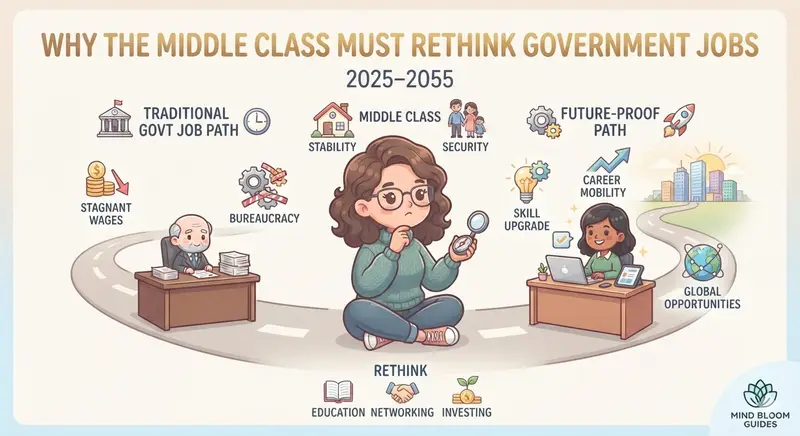
Why the Middle Class Must Rethink Government Jobs (2025–2055)
For generations across the Indian subcontinent, three words have held an almost religious reverence inside middle-class drawing rooms: “Sarkari Naukri Lag Gayi” (Secured a Government Job). It was the ultimate social stamp of arrival—an untouchable insurance policy against poverty, a social status multiplier, and the undisputed pinnacle of matrimonial viability.
Yet, as we look ahead across the 35-year career horizon spanning 2025 through 2060, the socio-economic conditions that once justified this obsession have fundamentally disintegrated. What made brilliant strategic sense for an applicant in 1975, 1985, or even 1995 has transformed into a high-risk, low-return trap for educated, middle-class and upper-middle-class youth today.
This analysis does not address the brave men and women who enter the uniformed defense services—the Army, Navy, Air Force, and frontline border forces. Putting on the uniform to protect the nation against geopolitical adversaries is not an economic transaction; it is a sacred calling.
Instead, this critique focuses squarely on the civilian administrative apparatus: from clerical cadre and state public service commissions (PSCs) to central ministries, public sector undertakings (PSUs), and the Indian Administrative Service (IAS).
For the modern middle-class family, pushing a young graduate into the relentless meat-grinder of government job competitive examinations is no longer prudent risk management. It is an act of economic self-sabotage. Here is an exhaustive, data-driven analysis of why.
The Historical Blueprint: How the “Pakki Naukri” Mindset Was Born
To understand why parents cling to the government job illusion, one must understand the psychological scars of modern Indian economic history:
[Colonial Babu Paradigm (Pre-1947)]
       │  ↳ Bureaucracy used as an instrument of state control and rent extraction
       ▼
[Socialist License Raj (1947–1991)]
       │  ↳ Private enterprise throttled; job scarcity; state as sole stable employer
       ▼
[The Post-1991 Transition Shock]
       │  ↳ Rapid private sector growth alongside persistent middle-class risk aversion
       ▼
[The 2025–2060 Economic Frontier]
          ↳ Digital governance eliminates discretion; high-skill enterprise creates real wealth
During the License Raj, private enterprise was throttled by state quotas, capital controls, and suffocating red tape. The private sector was small, unpredictable, and often unstable. The government was not just the premier employer; it was practically the only employer that offered dignity, a predictable pension, and insulation from systemic poverty.
Out of this scarcity emerged an emotional operating system: the worship of absolute tenure. A “permanent job” meant you could work at a leisurely pace, receive guaranteed annual increments, never worry about termination, and extract lifetime post-retirement pensions.
However, clinging to a 1980s survival strategy within a rapidly digitizing, highly dynamic market economy creates a massive strategic disconnect. When parents project their historical trauma onto children entering the modern workforce, they force their children into a model designed for a world that no longer exists.
Factor 1: The Cold Mathematics of Selection (The Base Rate Fallacy)
The most urgent reason middle-class parents should steer their children away from government examinations is rooted in elementary probability: the base rate of selection is practically zero.
Human psychology suffers from the optimism bias—every parent genuinely believes their child is uniquely brilliant, disciplined, and destined to be the exception. But examine the macro-level numbers:
The Demographic Expansion vs. Static Vacancy Paradox
| Metric | Circa 1995–2000 | Present Day (2025–2026 Baseline) | Shift Factor |
|---|---|---|---|
| Annual Class 12 Graduates | ~800,000 – 1,000,000 | ~14,000,000+ | ~14x Increase |
| Annual College Graduates | ~1,500,000 | ~10,000,000+ | ~6.6x Increase |
| UPSC CSE Group ‘A’ Posts | ~800 – 1,100 | ~750 – 1,000 | Stagnant / Declining |
| SSC / State PSC Openings | Highly localized | Consolidated & Often Frozen | Volatile / Decreasing |
| Selection Probability | ~0.1% to 0.2% | < 0.01% (1 in 10,000) | Statistically Negligible |
While the cohort of degree holders competing for administrative positions has multiplied more than tenfold over the last quarter-century, the absolute number of elite administrative openings has remained static or declined due to departmental rightsizing and fiscal constraints.
The Democratization of Education and the Loss of Middle-Class Moats
Twenty-five years ago, an upper-middle-class candidate from an urban center enjoyed a massive competitive advantage. They had access to premier libraries, elite English-medium schooling, specialized coaching hubs in Delhi, and expensive reference materials that were physically inaccessible to rural candidates.
Technology has obliterated that moat.
Today, complete lecture series, comprehensive notes on geography, polity, economics, and history, along with micro-level test series, are available across YouTube, Telegram, and low-cost EdTech platforms for near-zero cost. The son of a marginal farmer in rural Bihar or the daughter of an auto-rickshaw driver in an interior district has access to the exact same conceptual frameworks as a student living in South Delhi or South Mumbai.
Historical Advantage (1995):
[Urban Middle Class] ──(Elite Libraries + Coaching Hubs)──► High Selection Edge

Modern Reality (Post-2025):
[Hyper-Democratized Content] ──(YouTube + 5G + Open PDFs)──► Level Playing Field
                                                                    │
                    Driven by Existential Necessity ────────────────┘
                    Result: Relentless 16-Hour Daily Effort
The “Belly Fire” Equation
When educational content is democratized, the competitive differentiator shifts entirely to pure, desperate stamina.
A candidate from an economically vulnerable background is fighting for existential survival. A Group ‘C’ or Group ‘B’ post permanently rescues their entire lineage from generational poverty. They have zero fallback plan, no ancestral assets, and nothing to lose. They can—and routinely do—study 16 to 18 hours a day in cramped, non-air-conditioned rooms for five consecutive years because the alternative is economic oblivion.
By contrast, a middle-class or upper-middle-class child has grown up with basic comforts: air-conditioned bedrooms, family vacations, reliable nutrition, personal smartphones, and a financial safety net. They do not possess—nor should they need to possess—that degree of existential desperation.
When well-meaning parents push their comfortable middle-class child into a zero-sum memorization battle against someone driven by existential survival, the outcome is statistically predictable. Expecting a comfortable child to match that sheer, desperate output is an unrealistic expectation that frequently leads to chronic anxiety, clinical depression, and self-worth destruction.
Factor 2: The Sunk-Cost Trap and the Obliteration of the 20s
The most precious, non-renewable asset an individual possesses is not capital; it is the decade between ages 21 and 30. This is the physiological and cognitive window characterized by maximum neuroplasticity, peak physical energy, minimal family caretaking liabilities, and the highest risk tolerance.
In the private sector, high-tech, or enterprise, compounding starts immediately:
$$\text{Career Capital} = (\text{Core Skills} \times \text{Execution Iterations})^{\text{Time in Market}}$$
In government exam preparation, that dynamic is completely inverted.
Age 21: Graduation ──► "Just 1 Attempt to test the waters"
Age 22: Attempt 1 ──► Missed Prelims by 2.5 marks ──► "Sunk cost: I was so close!"
Age 23: Attempt 2 ──► Cleared Prelims, failed Mains ──► "I must double down."
Age 24: Attempt 3 ──► Cleared Mains, reached Interview ──► Missed final list by 4 marks
Age 25: Attempt 4 ──► Changed optional subject ──► Failed Prelims (burnout set in)
Age 27: Attempt 5 ──► Mental exhaustion, resume blank, friends are Senior Managers
Age 28: Attempt 6 ──► Reality check: 7 years elapsed, zero market-ready skills
The Multi-Attempt Cycle: A Disguised Economic Quagmire
The civil services examination structure functions like a high-stakes casino:
- Prelims: A brutal, high-variance elimination filter where negative marking and ambiguous questions create wild swings in outcomes.
- Mains: Subjective evaluation spanning nine descriptive papers, vulnerable to examiner bias, scaling metrics, and optional subject volatility.
- Interview/Personality Test: A subjective 30-minute evaluation capable of swinging a candidate’s rank by hundreds of spots.
Because candidates often clear one stage only to fall at the next, they fall victim to the classic gambler’s fallacy: “I reached the interview round this year, which means next year I am guaranteed an administrative rank.”
They re-enter the cycle. By the time they finally exhaust their attempts or walk away out of psychological exhaustion, the clock reads 28 or 29 years old.
The Opportunity Cost Comparison
Consider two individuals from the exact same middle-class background who graduated together at age 21:
[Candidate A: The Aspirant]
Age 21–28: Memorizing static history, polity, and geography notes
Age 28 Result: Zero workplace skills, zero equity, entry-level struggle

[Candidate B: The Market Builder]
Age 21–28: Learns product strategy, sales, code, or corporate finance
Age 28 Result: 7 years of compounding, equity grants, global mobility
While Candidate A spent their 20s in social isolation trying to master static syllabi, Candidate B:
- Navigated corporate politics, built negotiation leverage, and mastered team leadership.
- Acquired scalable, market-tested competencies (e.g., enterprise sales, full-stack software development, supply chain logistics, operations).
- Accumulated liquid capital, invested in compounding market assets, and secured equity/ESOPs.
- Retained full international mobility, capable of taking remote roles or emigrating.
When Candidate A finally enters the open job market at age 28 with a blank curriculum vitae, they discover that their vast knowledge of 16th-century administrative reforms or constitutional amendments carries zero market value in a modern enterprise economy. They are forced to start at the bottom of the private food chain, outpaced by 22-year-old fresh graduates.
Factor 3: The Depreciating Currency of Bureaucratic Prestige
Middle-class parents frequently harbor an archaic image of administrative prestige: flashing red beacons (Lal Batti), police escorts, massive colonial bungalows, unquestioned local authority, and lifelong financial protections.
Every single one of these pillars has either been systematically dismantled or is slated for obsolescence over the coming decades.
Traditional Perks (Pre-2004)        Modern Reality (2025 & Beyond)
┌──────────────────────────────┐    ┌──────────────────────────────┐
│ • Defined Benefit Pension    │    │ • National Pension System    │
│ • "Lal Batti" & Sirens       │───►│ • Banned / Stripped Down     │
│ • Complete Opacity           │    │ • Digital Trails, CPGRAMS    │
│ • Arbitrary Discretion       │    │ • Faceless Portals, Direct API│
└──────────────────────────────┘    └──────────────────────────────┘
1. The Death of Defined Pensions
The single greatest economic rationale for a government job disappeared on January 1, 2004, when the Old Pension Scheme (OPS) was replaced by the defined-contribution National Pension System (NPS) for central government entrants. Under OPS, retired officers received 50% of their last drawn basic pay adjusted for inflation (Dearness Relief) for the rest of their lives, guaranteed by state coffers.
Under NPS, government employees are market participants just like corporate employees—their retirement corpus is tied directly to market performance, stripping away the bedrock argument of guaranteed post-retirement state funding.
2. The Systematic Dismantling of Discretionary Power
Historically, the prestige of the civil servant stemmed from their nuisance value—their ability to say “no,” to withhold permissions, to sit on files, and to demand deference before granting an approval.
Over the last decade, the Indian state has deliberately deployed digital infrastructure to systematically eliminate bureaucratic gatekeeping:
- Direct Benefit Transfer (DBT): Hundreds of welfare schemes now bypass intermediaries entirely, moving capital directly from the treasury via Aadhaar-linked bank accounts.
- Faceless Tax Assessments: Income tax scrutiny is now algorithmically assigned across jurisdictions; taxpayers no longer interact with local assessment officers, eliminating transactional leverage.
- Unified Digital Portals: From obtaining a passport via Passport Seva to customs processing, business incorporations, and municipal building approvals, interactions are increasingly handled through digital ticketing systems featuring mandatory turn-around-time (TAT) service level agreements.
When an administrative process transitions from a physical desk to an automated API call, the bureaucrat’s discretionary authority vanishes. A system built on transparency, audit logs, and digital monitoring reduces the all-powerful officer to an administrative process manager.
3. The Rightsizing of State Capacity
Western economies recognized decades ago that a modern state cannot afford a bloated, lifetime-salaried civilian workforce. As the Indian government continues to invest in capital expenditures (highways, ports, digital public infrastructure, defense modernization), fiscal realities require the progressive compression of revenue expenditures (salaries and pensions). Lateral entry programs, contractual hiring, and outsourced administrative divisions are structurally expanding. The era of expanding secure civilian desks is firmly over.
Factor 4: Spousal Career Cannibalization and Domestic Friction
One of the least discussed yet most destructive consequences of entering administrative government service is its devastating impact on household earning potential and marital equilibrium.
In the modern economic landscape, household wealth creation is driven primarily by Urban Dual-Income Households (UDIH). When two educated partners work in metropolitan commercial centers, their combined earning power, tax planning advantages, and network compounding create long-term financial resilience.
Civil administrative careers completely derail this engine.
Scenario A: The Metro Dual-Income Household
Partner 1 (Tech / Product):   ₹22,00,000
Partner 2 (Finance / Legal):  ₹20,00,000
Total Gross Household Income:  ₹42,00,000  (Plus dual PF, dual equity, prime urban mobility)

Scenario B: The Group 'A' Administrative Household
Partner 1 (Govt Service):     ₹15,00,000 (Gross Pay; posting: Tier-3 District)
Partner 2 (Forced Dependent): ₹0         (Career abandoned due to lack of local market)
Total Gross Household Income:  ₹15,00,000  (Heavy transfer costs, low spousal autonomy)
The Geographies of Economic Isolation
A corporate, creative, tech, or financial professional requires proximity to major commercial clusters—Bengaluru, Mumbai, the National Capital Region (Gurugram/Noida), Hyderabad, or Pune.
A civil servant, conversely, is subject to the administrative needs of the state cadre. Over a 30-year career, an officer is routinely posted as a Sub-Divisional Magistrate (SDM), District Magistrate (DM), Chief Executive Officer of a Zilla Parishad, or departmental director in remote, rural, and semi-urban outposts:
[Cadre Allocation] ──► [Remote District Posting]
                              │
       ┌──────────────────────┴──────────────────────┐
       ▼                                             ▼
[Spouse Abandons Career]                    [Spouse Stays in Metro]
  ↳ Long-term earning loss                    ↳ Geographically fractured home
  ↳ Resentment & identity loss                ↳ Double rent, high travel costs
  ↳ Complete economic dependency              ↳ Chronic domestic friction
If the officer’s spouse is a corporate attorney, a software engineer, an architect, or an investment analyst, their career is effectively over the moment they relocate to a remote district. There is no corporate ecosystem there.
The alternative is maintaining two separate households: one partner living in a metropolitan center while the officer lives in their official posting. This dynamic forces double rent, massive travel expenditures, long-distance domestic stress, and fragmented parenting for decades.
The Myth of the “Dual-Officer” Solution
Some suggest the ideal path is marrying another civil servant. While cadre allocation rules theoretically attempt to place officer couples within the same state cadre, administrative realities frequently separate them across different districts or departments for years.
Furthermore, having two spouses working in the same bureaucratic system concentrates all household risk into the very same state apparatus: inflexible schedules, administrative scrutiny, constant political exposure, and zero exposure to private wealth generation.
Factor 5: The Staggering Opportunity Cost in an Expanding Economy
Between 2025 and 2055, India is projected to undergo the most aggressive phase of capital formation, technological adoption, and private wealth creation in its history. During this 30-year window:
- Massive public-to-private capital rotation will compound across equity markets.
- High-margin export services, domestic manufacturing ecosystems, and deep-tech automation will build substantial private fortunes.
- Intellectual property, software products, and private equity ownership will create unprecedented numbers of self-made high-net-worth individuals.
Joining the civil service permanently bars an ambitious individual from participating in this historic economic expansion.
The Shackles of the Central Civil Services (Conduct) Rules
The moment a candidate takes the oath of civil service, they are legally bound by stringent administrative conduct rules:
                        CENTRAL CIVIL SERVICES (CONDUCT) RULES
                                     │
       ┌─────────────────────────────┼─────────────────────────────┐
       ▼                             ▼                             ▼
[Rule 15: No Private Trade]    [Rule 16: No Active Trading]   [IP & Media Restrictions]
Cannot found a startup;        Cannot actively trade equities; Cannot freely publish,
cannot monetize a side-hustle; cannot hold advisory board     monetize YouTube, or build
cannot sit on private boards.  seats or take angel equity.    commercial personal brands.
- Prohibition of Enterprise (Rule 15): A government servant cannot directly or indirectly engage in any private trade, business, or commercial undertaking. They cannot build a side business, launch a SaaS platform, manage an agency, or consult for emerging startups.
- Investment Restrictions (Rule 16): A government servant is prohibited from speculating in investments. Frequent day trading, active portfolio management, or holding equity stakes in ventures within their operational jurisdiction triggers immediate vigilance scrutiny.
- Intellectual Property and Voice Restrictions: A civil servant cannot freely write, publish commercial media, build a monetized YouTube platform, or run digital properties without explicit departmental sanction.
Linear Compounding vs. Exponential Wealth Creation
Consider the macroeconomic math of lifetime earnings over a 35-year working career:
Annual Income
  ▲
  │                                                     / Private High-Skill Path
  │                                                    /  (Base + Equity + Freedom)
  │                                                   /
  │                                                  /
  │                                                 /
  │                                                /
  │                      -------------------------  Government Career Path
  │                     /                           (Capped Grade Pay + DA)
  │                    /
  │                   /
  │──────────────────/─────────────────────────────► Time (Years)
  0                  10                  20       35
A civil servant’s financial trajectory is strictly linear:
$$\text{Income}_{\text{Govt}} = \text{Basic Pay} + \text{Dearness Allowance (DA)} + \text{HRA}$$
Even at the pinnacle of the administrative pyramid—a Secretary to the Government of India (Cabinet Secretary grade)—the monthly basic pay tops out at roughly ₹2,25,000 to ₹2,50,000 per month. Even factoring in allowances, official transport, and housing subsidies, total legal compensation is structurally capped.
In the modern enterprise ecosystem, professionals in senior engineering, product architecture, venture-backed startups, corporate law, quantitative finance, or specialized consulting routinely surpass the lifetime post-tax earnings of a retired Chief Secretary before they hit age 35.
More crucially, the private professional builds equity: stock options, private company holdings, and index-compounded capital that generate generational wealth completely decoupled from their daily physical presence.
Factor 6: The Quality-of-Life Paradox of Government Quarters
The pervasive myth of the government lifestyle revolves around the “free bungalow.” Parents point to sprawling colonial residences with manicured lawns as the ultimate visual symbol of status.
The everyday reality for 95% of government employees is radically different: the chronic degradation of living inside decaying Public Works Department (PWD) housing.
THE REALITY OF PWD HOUSING
├── Decaying Infrastructure: Built between 1970–1990; peeling damp walls, aging plumbing.
├── Maintenance Paralysis: Bureaucratic ticketing for minor issues (leaks, electrical faults).
├── Zero Tenant Customization: Cannot modernize infrastructure or upgrade layouts.
└── Urban Downgrade: High-earning officers living in low-spec environments.
The Architectural Stagnation of the Civil Service Colony
Unless an officer reaches the rare post of a District Collector or a Chief Secretary, they are assigned standard Type-IV or Type-V government quarters. Built decades ago using low-bid government procurement tenders, these colonies are frequently characterized by:
- Pervasive wall dampness, peeling lime wash, and corroded external plumbing.
- Outdated bathrooms with poor water pressure and aging ceramic fittings.
- Inefficient electrical wiring incapable of handling modern heat pump, HVAC, or high-draw appliance loads without blowing local distribution fuses.
- Complete reliance on unresponsive local engineering departments for basic repairs.
The Standard-of-Living Distortion
This dynamic creates a bizarre lifestyle paradox: an individual holding an executive administrative rank often lives in physical conditions far inferior to a mid-level corporate employee earning ₹12,00,000 a year.
A private-sector professional can lease a home in a modern, master-planned residential community featuring treated domestic water, central power backup, integrated fitness clubs, responsive facility management, clean common areas, and modern high-spec bathrooms.
A civil servant, by contrast, frequently spends 35 continuous years trapped in dilapidated government housing, enduring leaky fixtures and institutional grey walls, simply because moving out forfeits their official House Rent Allowance (HRA) and invites scrutiny from peers. They endure four decades of compromised daily living standards all to maintain the illusion of state-provided housing.
Factor 7: The “Circus Lion” Paradox (Autonomy, Toxicity, and Transfers)
Perhaps the most compelling analogy for the modern civilian administrative apparatus is the Circus Lion.
                           THE CAREER FREEDOM SPECTRUM
                                        │
           ┌────────────────────────────┴────────────────────────────┐
           ▼                                                         ▼
   THE CIRCUS LION                                            THE WILD LION
 (Civil Administrative Life)                                 (Dynamic Market Life)
 • Guaranteed meals on a fixed schedule                     • Must hunt to survive
 • Cannot escape the ringmaster's whip                      • Full operational autonomy
 • Paced cage; zero spatial mobility                        • Roams the entire landscape
 • Atrophied muscles; dependent on keepers                  • Razor-sharp, adaptive survival skills
The circus lion enjoys predictable meals. It does not worry about where its next meal comes from; every afternoon, meat is delivered through the iron bars of its enclosure.
However, the lion remains trapped inside an iron cage. When the ringmaster enters with a whip, the lion must jump through hoops, sit on command, and roll over. It cannot walk away. It cannot change rings. It cannot fire the ringmaster.
The Punitive Transfer as an Instrument of Control
The private sector employee enjoys the ultimate power in a free market economy: the right to resign.
If a corporate employee works under an abusive manager, endures an unprincipled executive, or finds their work environment toxic, they can update their resume, leverage their professional network, tender a 30-day notice, and transition to a competitor.
A civil servant does not have this freedom. Under administrative service rules:
- You cannot easily resign without sacrificing your entire career investment.
- You cannot refuse a transfer order. If a politically connected superior or an elected minister finds your adherence to regulatory rules inconvenient, they can issue an executive order dispatching you overnight to an administrative backwater thousands of miles away.
- You are subject to constant administrative inquiries, vigilance probes, and political harassment designed specifically to enforce compliance.
Professional Friction in Modern Careers:
[Private Sector Friction] ──► Update Resume ──► Interview Elsewhere ──► Hand in Notice ──► Exit
[Bureaucratic Friction]   ──► Endure Humiliation ──► Punitive Transfer ──► No Market Recourse
In the civil service, your “customer” is not a consumer who pays you for value created; your master is an elected political executive whose short-term electoral priorities often directly clash with rational administrative governance.
A civil servant spends decades suppressing their intellect, rubber-stamping questionable political policies, navigating hostile local factions, and living under the constant threat of transfers—all to preserve the guaranteed meal delivered through the bars of their administrative cage.
Comprehensive Comparison: The Civil Service vs. The Dynamic Modern Enterprise
To understand how drastically the two career trajectories diverge over a 35-year working lifespan, consider this systematic structural comparison:
| Evaluation Dimension | Group ‘A’ / Civil Services Bureaucracy | High-Skill Private Enterprise & Modern Venture |
|---|---|---|
| Selection Probability | < 0.01% (Extremely high variance, multi-year sunk cost) | High (Iterative, skill-based, multi-firm entry points) |
| Preparation Period ROI | Zero if unselected; static generalist knowledge base | Highly compounding; code, product, sales, and analytics skills |
| Lifetime Financial Upside | Strictly linear; basic pay + inflation allowances (NPS bound) | Non-linear; performance bonuses, market equity, and ESOPs |
| Spousal Career Compatibility | Catastrophic; frequent remote and semi-urban transfers | High; concentrated in major metropolitan and tech centers |
| Daily Physical Quality of Life | Aging, state-maintained housing colonies; poor upkeep | High-spec modern residential infrastructure; private flexibility |
| Operational Autonomy | Subservient to political masters; punitive transfer risk | High; ability to resign, change firms, or freelance |
| Global Mobility | Near zero; knowledge is locked to specific national codes | High; technical, operational, and management skills travel globally |
| Freedom to Build Side Assets | Strictly banned by Central Civil Services Conduct Rules | Permitted; investing, advisory, content, and IP creation |
The Societal Dimension: Step Aside for Generational Mobility
Beyond individual economics, there is an urgent ethical and sociological imperative for middle-class and upper-middle-class families to exit the government job pipeline.
Consider how a Group ‘A’ or Group ‘B’ government appointment impacts different strata of Indian society:
[Family 1: Agricultural Laborer / Marginal Household]
Candidate Secures Group 'A' Post
        │
        ▼
Generational Poverty Broken Permanently
        │
        ↳ Immediate social elevation, debt elimination, relatives educated,
          historic empowerment of an entire community lineage.

[Family 2: Urban Upper-Middle-Class Household]
Candidate Secures Group 'A' Post
        │
        ▼
Marginal Status Maintenance
        │
        ↳ Parents already own a home; candidate trades dynamic wealth creation
          for an administrative desk; society gains zero net productive output.
When a first-generation learner from a drought-prone district clears a public service commission exam, it transforms their entire community. It represents authentic, life-altering social mobility. The systemic security of a state post changes that family’s socioeconomic trajectory for the next hundred years.
When the child of an established urban professional, an engineer, a doctor, or an existing senior bureaucrat spends seven years memorizing general knowledge textbooks to win an administrative desk, it represents a profound misallocation of talent.
The urban middle class already possesses the cultural capital, financial safety net, and foundational networks needed to take calculated risks: building businesses, leading technical innovations, creating private employment, and competing on the global stage.
By obsessively chasing state administrative openings, comfortable families crowd out candidates who genuinely depend on these posts for basic survival, while sheltering their own children from developing the real-world skills needed to thrive in a global economy.
The Strategic Blueprint: Raising “Wild Lions” for 2025–2055
If middle-class parents should pull their children back from the government job trap, what should they direct them toward instead? How should families approach the next three decades?
                     A 4-STEP PARENTAL PIVOT FOR THE MODERN ERA
                                         │
       ┌────────────────────────┬────────┴────────┬────────────────────────┐
       ▼                        ▼                 ▼                        ▼
[Step 1: Cap the Attempt] [Step 2: Start Early] [Step 3: Build Leveraged] [Step 4: Shift from
  Strict 1–2 attempt        Earn by age 20–22;     Focus on code, sales,    Prestige to Wealth]
  cutoff; pivot at 24.      compound investments  product, & analytics.    Prioritize freedom
                            immediately.                                    over bureaucratic titles.
1. The Strict Two-Attempt Rule
If an educated graduate is genuinely passionate about public policy and public service, they should not be banned from trying. However, family leadership must enforce hard, non-negotiable boundaries:
- Maximum of two attempts.
- Complete cutoff by age 23 or 24.
- If selection does not happen by the second attempt, the candidate must walk away permanently.
No third attempts, no changing optional subjects, no moving into underground coaching hubs for five-year preparation cycles. Treat the early 20s as sacred capital that cannot be gambled away.
2. Prioritize Early Financial Velocity Over Exam Preparation
The path to true financial independence in the modern era begins with earning early.
A young adult who starts earning even modest income at age 20, 21, or 22—through freelancing, early corporate roles, technical apprenticeships, or specialized services—builds an invaluable psychological asset: market confidence. They learn what the real world actually values, how to negotiate, how to handle difficult colleagues, and how to manage liquid cash.
By deploying small, systematic monthly savings into broad-market index equities starting at age 21, the power of compound interest works in their favor across an entire 40-year investment horizon. By the time an exam aspirant emerges from their preparation at age 28 with zero savings, the early earner has already built a compounding investment portfolio that provides genuine, lasting security.
3. Cultivate Asymmetric, High-Leverage Skills
Rather than testing a child’s capacity for rote memorization of static facts, direct their energy toward modern asymmetric skills—capabilities where effort scales non-linearly:
- Software Architecture & Artificial Intelligence Systems: Building, integrating, and fine-tuning automated computational workflows.
- Complex Enterprise Sales & Deal Architecture: The human ability to build trust, navigate organizational politics, and close multi-million-dollar commercial agreements.
- Product Strategy & User Psychology: Designing digital tools and physical products that solve urgent human frustrations.
- High-Value Creative Execution: Clear writing, video production, brand strategy, and cross-border distribution.
These skills are borderless. An individual who masters these fundamentals can work for an enterprise in Bengaluru, consult for a venture in Berlin, or manage clients remotely in San Francisco, earning top-tier global currencies while living wherever they choose.
4. Transition Family Mindsets: From External Prestige to Genuine Autonomy
The ultimate barrier remains parental status anxiety: “What will we tell our relatives at social gatherings if our child doesn’t have an impressive government title?”
Parents must overcome this outdated social reflex. The approval of extended family members will not fund your child’s retirement, preserve their mental health, or pay for their children’s education.
True social status in the modern world is not a state title, an administrative grade pay slip, or an aging PWD flat.
True status is autonomy.
True status is the freedom to work from anywhere, sleep without fear of punitive transfers, spend unhurried time with family, build equity that outlives you, and resign instantly from any environment that insults your integrity.
That freedom cannot be granted by an administrative appointment letter from a state department. It must be forged through real-world competence, market relevance, and financial discipline in the open arena of the modern economy.
Conclusion: The Path Forward
The civilian government job was the defining ambition of 20th-century India—an era defined by post-colonial scarcity, socialist policy, and defensive survival. It served its historical purpose for generations of families who needed safe, state-backed employment to climb out of extreme poverty.
That era is over.
For the young people who will build their careers between 2025 and 2060, the state is no longer an efficient vehicle for personal ambition, wealth creation, or family well-being. The competitive mathematics are stacked against them, the opportunity costs are unacceptably high, the historical perks have evaporated, and the structural constraints of the civil service run counter to modern quality of life.
It is time for India’s educated middle class to abandon the illusion of “Pakki Naukri.”
Let civilian administrative posts serve their proper role: stepping stones for those breaking out of generational poverty. For everyone else, step out of the preparation centers and into the open economy. Stop raising your children to be circus lions performing inside a bureaucratic cage. Teach them to hunt, build, innovate, and thrive as wild lions in an expanding economic world. That is where their future—and the future of the nation—truly belongs.
Frequently Asked Questions
Does this analysis apply to armed forces and defense services?
No. Uniformed services (Army, Navy, Air Force) represent a sacrificial calling dedicated to national defense and sovereign protection. This analysis focuses strictly on civilian administrative bureaucracy, public sector undertakings, and state civil services.
Why should middle-class aspirants avoid civil services if they want job stability?
Job stability in civilian government roles comes at the cost of immense opportunity loss, geographical dislocation, spousal career sacrifice, and zero equity upside during India's highest-growth economic decades.
What should parents do if their child is already preparing for civil services?
Set a strict, non-negotiable two-attempt cutoff. If selection does not happen by age 23 or 24, pivot immediately to the private sector, high-skill tech, global freelancing, or enterprise where experience compounds financially.
Written by
The OD Team
Main Writer & Editorial Team
The OD Team is the core writing and editorial team behind The Orange Desk. We research, write, fact-check and update every guide on money, technology and everyday decisions, so you get clear, practical answers you can act on.
View full profile →