How to Stop Regretting Missed Opportunities: The Complete Guide
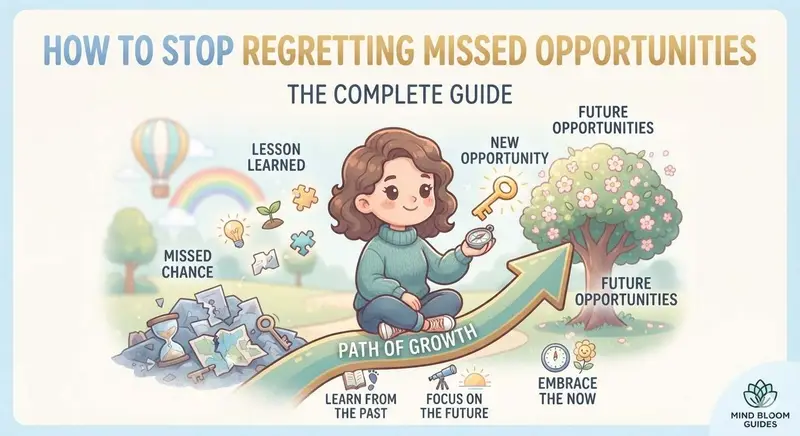
Have you ever found yourself lying awake at 2:00 AM, replaying a single moment from five years ago? If you want to learn how to stop regretting missed opportunities, you first have to understand why your brain obsesses over the past. We convince ourselves that one bolder choice would have launched our careers or relationships into an entirely different stratosphere.
Here is the truth: looking backward with self-contempt will never fix forward momentum. In this guide, you will learn how to dismantle the trap of retrospective regret, audit your past decisions with radical honesty, and turn delayed courage into your greatest competitive advantage.
The Psychology of the “Why Didn’t I Do It Then?” Spiral
The heaviest questions in life are rarely about what you should tackle tomorrow morning. The questions that genuinely paralyze us look backward: “Why didn’t I speak up during that meeting?” or “Why didn’t I take that offer when I had the chance?”
We carry a mental catalog of every single exit ramp we failed to take. That catalog might hold a job interview you canceled, a city you were too nervous to move to, or a relationship where you froze instead of leaning in.
When you look back at those moments, your brain plays an unfair psychological trick on you. It assumes that because you see the right answer clearly now, that same clarity was readily available back then.
Psychologists call this phenomenon hindsight bias. It leads you to believe an outcome was totally predictable simply because the final result has already played out.
[Past Event Occurred]
       │
       ▼
[Years of Experience & Lessons Gained]
       │
       ▼
[Present Self Judges Past Self Unfairly] ◄── Hindsight Bias Trap
You look at your past self and feel shame because you think you lacked willpower. You tell yourself that someone braver, sharper, or more driven would have seized that open door instantly.
Before long, that single hesitation becomes a permanent indictment of your character. You stop viewing the event as an isolated decision and start viewing it as proof of personal cowardice.
That is where the loop turns toxic. When you label yourself as someone who chokes under pressure, you undermine the confidence you need to capture the very opportunities standing right in front of you today.
Unpacking the “Backstage Reality” of Your Past Decisions
Whenever you look back at a missed opportunity, you are only looking at the front stage of your life. You see the open door, the title, the potential salary, or the adventure that slipped through your fingers.
What you conveniently forget is your backstage reality. You forget the hidden emotional state, physical exhaustion, and invisible obligations that were crowding your mental space that week.
Let’s look at what is actually happening behind the curtain when people freeze:
- Acute cognitive fatigue: Your mental bandwidth was completely drained by survival, leaving zero reserve energy to process risky transitions.
- Deep internal confusion: You did not possess enough clean data or emotional calm to evaluate the trade-offs accurately.
- Invisible responsibilities: You were holding together family pressures, financial debts, or health concerns that made conservative decisions necessary.
- An unaddressed need for stillness: Your nervous system was desperately signaling for rest, not another massive leap into the unknown.
[Insert Screenshot Placeholder: The Backstage Bandwidth Audit Matrix showing Front-Stage Desires vs. Backstage Reality]
Think about that moment you regret with brutal objectivity. Were you actually energized, clear-headed, and completely free of outside drag on that specific Tuesday morning?
Of course you were not. You were managing a complex ecosystem of fears, obligations, and physical limitations that made pausing the most rational self-preservation instinct you had.
You did not say “no” or back away because you were weak. You made the safest, most stable call you could make based on the specific fuel available in your tank at that exact hour.
Punishing yourself now ignores the real context of your past life. Treating your past hesitation as laziness is just revisionist history that ignores your humanity.
If you are dealing with burnout from holding too many plates at once, explore our guide on managing career burnout to reset your operating capacity.
Why Courage Is a Contextual State, Not a Character Trait
One of our biggest cultural mistakes is treating courage like an engraved identity badge. We assume that high-performing people wake up bold, live bold, and go to sleep bold every single day of the year.
Courage is not a static character trait. It is a fluctuating situational response that depends entirely on your current emotional reserves, support systems, and environment.
Think of confidence like a small hand-held flashlight inside a pitch-black warehouse. That flashlight cannot illuminate all four corners of the room at the same time.
    [Your Life Circumstances]
               │
       ┌───────┴───────┐
       ▼               ▼
[Area in Light]  [Area in Shadow]
(Clear Action)   (Uncertainty / Pause)
Where the beam lands, the darkness disappears and action feels simple. But where the beam is not pointing, you are operating in deep shadows, and moving fast in the dark is reckless.
Just because the light was not pointing toward that career jump or that relocation does not mean your flashlight was broken. It simply means your focus was required somewhere else to keep your life from falling apart.
Stop looking at others and asking why they take risks you shy away from. You are comparing their front-stage highlight reel to your messy backstage production.
They might have a safety net, an emotional buffer, or a specialized background that makes that exact leap low-risk for them. For you, at that time, the same leap might have meant total disaster.
When you understand that courage rises and falls based on context, you stop labeling yourself as a coward. You realize you were simply operating in low light.
The Hindsight Paradox: Judging Past Weakness with Present Strength
Do you want to know the ultimate irony behind your current regret? The only reason you recognize that past missed opportunity so clearly today is because of the confidence and wisdom you developed after missing it.
Think about that sequence for a moment:
- You hesitated and watched a promising opportunity slip away.
- You felt the sting, endured the setback, and were forced to adapt to the fallout.
- You picked yourself back up, rebuilt your life, and developed deeper resilience.
- You now look back at step one using the wisdom you only earned during steps two and three.
It is a complete paradox. You are taking the strength, emotional intelligence, and tactical judgment you have right now, and using it as a weapon against a version of you who had none of those tools.
The person you were back then had not survived the trials that shaped who you are today. That earlier version of you was still untested, vulnerable, and gathering baseline data about the world.
If that massive opportunity had been handed to you back then, you likely would have dropped it anyway. You lacked the internal scaffolding required to carry the weight of that success.
Life sometimes forces you to miss a door so you are compelled to build the muscle required to walk through the next three doors properly. That delay is not a permanent punishment; it is preparation.
The version of you reading this article is entirely different from the version that hesitated years ago. Stop demanding master-level performance from someone who was still in the middle of their apprenticeship.
How to Stop Regretting Missed Opportunities in 5 Actionable Steps
Healing from retrospective regret requires more than pleasant platitudes. You need a structured, repeatable operating procedure to break the mental loop whenever past decisions resurface.
Here is a 5-step framework you can run through whenever an old regret tries to hijack your afternoon.
┌───────────────────────────────────────────────────────────┐
│              THE 5-STEP REFRAMING WORKFLOW               │
├───────────────────────────────────────────────────────────┤
│ 1. Isolate the Event (Remove dramatic adjectives)         │
│ 2. Audit Backstage Constraints (List 3 hidden pressures)  │
│ 3. Separate Latency from Fraud (Acknowledge honest intent)│
│ 4. Extract the Core Operating Rule (Turn pain into data)  │
│ 5. Construct the Forward Trigger (Define the next action) │
└───────────────────────────────────────────────────────────┘
Step 1: Strip the Event of Dramatic Adjectives
When we obsess over missed chances, we use inflated, tragic language. We tell ourselves: “I ruined my single shot at happiness,” or “I threw away my dream career.”
Sit down with a blank sheet of paper and write down the facts of what happened using purely clinical terms. Remove words like “catastrophic,” “ruined,” “cowardly,” or “perfect.”
State only what took place: “In October 2021, I received an invitation to interview for a director role, and I declined to submit the portfolio.”
When you remove emotional storytelling from the event, the monstrous regret turns back into what it actually was: a tactical choice made under specific conditions.
Step 2: Conduct an Honest Constraint Audit
Underneath your clinical description, list the three biggest resource drains you were managing during that exact month. Force your memory to look backstage.
Were you sleeping four hours a night because of an infant or family illness? Were you battling a toxic manager who had systematically dismantled your self-worth over the previous twelve months?
Write those constraints down clearly:
- Constraint 1: Zero emergency savings to absorb a failed transition.
- Constraint 2: Severe physical exhaustion from an unmanageable commute.
- Constraint 3: Insufficient technical clarity on how the new role operated.
Look at those three bullet points. If a close friend came to you with those exact constraints, would you order them to take on high-stakes risks, or would you tell them to stabilize first?
You would tell them to stabilize every single time. Give yourself the same grace you extend to your colleagues.
Step 3: Run the Latency vs. Fraud Diagnostic
Ask yourself this straightforward question: Was my hesitation caused by malicious laziness, or did my courage simply arrive later than the deadline?
There is a massive distinction between being an imposter and having a delayed realization. If you genuinely cared, hoped, and tried your best within your bandwidth, your intentions were completely real.
Your courage was not fake; it was simply slower than the fast-moving calendar. Labeling late bravery as fake bravery is an intellectual lie that serves no productive purpose.
Step 4: Extract One Permanent Operating Rule
Pain that produces no data is a total waste of energy. Every missed opportunity holds a specific lesson about your decision-making boundaries.
Identify the exact breakdown point from that past event and translate it into an actionable operating rule for the future.
For example, if you missed a speaking opportunity because you waited too long to reply, your rule might be: “On external invites, I respond within 48 hours with either an absolute yes or a clean no.”
[Insert Screenshot Placeholder: Personal Decision-Making Protocol Template in a Notion workspace]
Once you convert a painful memory into a concrete rule, that memory loses its power to hurt you. It stops being an emotional failure and becomes paid tuition for your strategic growth.
For more frameworks on building structured personal protocols, read our guide on how to rebuild your daily focus.
Step 5: Direct the Acquired Energy into an Immediate Forward Trigger
Regret generates an enormous amount of mental friction. If you leave that energy sitting inside your head, it turns inward and erodes your self-esteem.
Take that friction and direct it outward into an immediate, physical micro-action within the next sixty minutes. Do not plan to do it tomorrow; execute a low-friction action right now.
- Send an introductory email to someone in an industry you find exciting.
- Sign up for the technical certification you avoided three years ago.
- Update your portfolio with your two most recent case studies.
- Block out thirty minutes on your calendar to draft a new proposal.
By taking immediate action, you break the rumination cycle. You prove to your subconscious mind that you are an active participant in your present life, not a helpless spectator trapped in your past.
“My Courage Was Late, but It Wasn’t Fake”: Reframing Delayed Action
There is an enormous emotional breakthrough waiting for you when you accept that late courage is still real courage. We live in a culture that worships split-second decisions and fast bravado.
We celebrate the person who jumps without looking, signs contracts impulsively, and speaks before thinking. But speed is rarely an indicator of depth, and fast action is often just uncalculated recklessness.
Authentic courage does not have to be instantaneous; it only has to be true when it finally surfaces.
When your courage arrives down the road, it is grounded in lived reality rather than temporary hype. It has been tested by the consequences of hesitation, making it substantially more durable.
Think about how strength actually develops in the real world:
[Impulsive Bravado]  ──► Fast to appear  ──► Shallow roots  ──► Breaks under pressure
[Delayed Courage]    ──► Slow to mature  ──► Deep roots     ──► Holds the line long-term
When you look back and say, “I see what I should have done,” that realization is proof that your internal compass works. You are learning to read the terrain of your life accurately.
A broken compass does not feel regret. A broken compass does not care that an opportunity got away.
The fact that it stings proves that your values are aligned correctly. It proves that you want to grow, contribute, and take on meaningful challenges in the future.
Say this out loud to yourself the next time the memory of an old failure strikes: “My courage was late that day, but it was not fake.” That small cognitive shift transforms self-pity into quiet, grounded readiness.
Turning “Not Yet” into Active Readiness for the Next Window
In life, missing a window does not mean the building has vanished. It simply means that particular door was labeled “Not Yet” by circumstances you could not control.
We often assume that every missed chance was our final shot at happiness or fulfillment. We treat our lives like a fragile single-elimination tournament where one dropped pass eliminates us forever.
Real growth behaves like a recurring league. New markets open up, new roles get created, new relationships form, and fresh projects require experienced leadership every single quarter.
       [Missed Opportunity]
                │
         (The "Not Yet")
                │
       ┌────────┴────────┐
       ▼                 ▼
[Bitter Regret]    [Active Preparation]
(Stay Paralyzed)   (Refine Skills, Rest Bandwidth)
                         │
                         ▼
             [Next Opportunity Appears]
                         │
                         ▼
             [Alignment: Timing + Courage]
The difference between those who eventually break through and those who stay stuck is how they utilize the interim period between opportunities.
Those who remain stuck spend the quiet season replaying old mistakes and feeling bitter. Those who break through treat the “Not Yet” as an intentional conditioning period to fix their backstage capacity.
They resolve their financial emergencies, shore up their technical skills, and protect their physical energy. They ensure that when the next open door appears, their backstage reality can support their front-stage ambitions.
When your personal readiness, your hard-earned courage, and an external opportunity finally sit on the exact same line, momentum becomes effortless. That alignment only happens because the pain of past delays taught you how to spot the opening early.
[Insert Screenshot Placeholder: Opportunity Recognition Matrix illustrating the intersection of Bandwidth and External Timing]
Frequently Asked Questions About Missed Opportunities
How do I stop beating myself up over a career chance I turned down years ago?
Shift your attention from the outcome to your real capacity at that time. Write down a factual list of the emotional, financial, and physical constraints you were managing during that exact season. Recognize that your decision was a protective survival response, extract one operational lesson from it, and apply that lesson to your current workflow.
What if the opportunity really was a once-in-a-lifetime moment?
Truly unique moments are far rarer than your anxiety suggests. While that specific company or person may not cycle back, equivalent opportunities to lead, build, create, and love recur constantly throughout a thirty-year career. Missing one specific vehicle does not mean your destination has been permanently erased.
How do I know if I am being cautious or just making excuses out of fear?
Examine your backstage bandwidth. If your hesitation stems from zero sleep, missing facts, or genuine family survival needs, you are exercising necessary caution. If your needs are met, the information is clear, and the only barrier is the discomfort of being seen trying, you are making excuses—and that is your signal to push forward.
Can an opportunity that slipped away ever be recreated?
You rarely recreate the exact same situation, but you can build an environment that attracts superior versions of it. By using the lesson from that missed chance to upgrade your skills, network, and baseline capacity, you position yourself to capture opportunities that your earlier self was completely unqualified to handle.
Why does regret over past decisions hit hardest late at night?
At night, your executive brain function is physically depleted, external distractions drop to zero, and your defenses against negative self-talk are at their lowest. When these spirals strike in bed, refuse to debate your past self in the dark; simply write the thought down on a pad, park it, and evaluate it under bright daylight after a full meal.
Your Next Move: Shifting from Blame to Tomorrow’s Courage
The time for self-punishment is officially over. You cannot rewrite the opening chapters of your career, and you cannot alter the choices made by an exhausted, younger version of yourself.
Look at your past with clear eyes and deep self-respect. Understand that every detour, pause, and missed window was part of the heavy conditioning required to build the person you are right now.
Here is your simple rule of thumb moving forward: Never judge a past decision using present capacity.
Take the sting you have been carrying around and let it dissolve into quiet resolve. Your courage was not missing—it was simply doing the slow, invisible work of growing roots deep enough to sustain your future.
The next window of opportunity is already swinging open. The only question that matters now is whether you will be looking backward when it arrives, or standing tall, clear-eyed, and completely ready to step through.
Now I want to hear from you: What is one past opportunity you have been holding against yourself, and what invisible constraint was your younger self dealing with at that time?
Leave a comment below right now and share your story. I read and reply to every single comment, and your transparency might give someone else the exact permission they need to finally let go and move forward!

Written by
The OD Team
Main Writer & Editorial Team
The OD Team is the core writing and editorial team behind The Orange Desk. We research, write, fact-check and update every guide on money, technology and everyday decisions, so you get clear, practical answers you can act on.
View full profile →