How Middle-Class Families Can Save ₹1 Crore on College & Weddings
 The OD Team Main Writer & Editorial Team 16 min read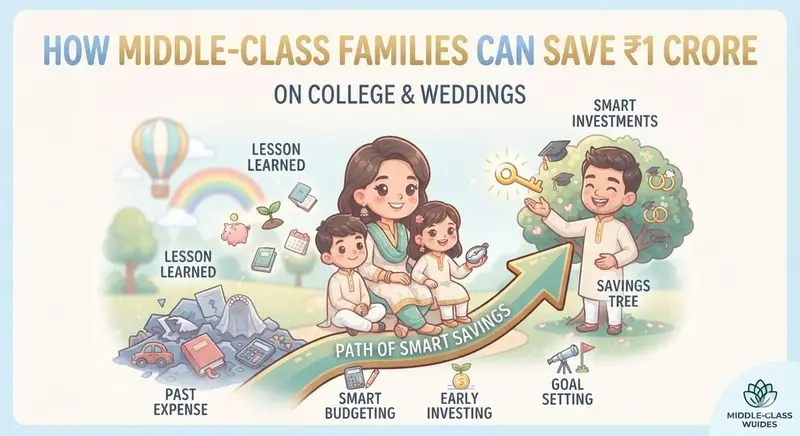
The ₹1 Crore Middle-Class Capital Drain: Reclaiming Wealth from Commoditized Education and Vanity Weddings
For the urban middle and upper-middle class, the path to long-term wealth is rarely derailed by catastrophic market crashes or overt consumer bankruptcy. Instead, it is quietly dismantled by two socially mandated, emotionally weaponized expenditures: private higher education credentials and extravagant matrimonial celebrations.
Consider the typical household balance sheet: parents who are salaried professionals or small-business owners earning between ₹18 Lakhs and ₹35 Lakhs annually. Over twenty to thirty years of relentless labor, they diligently service home loans, maximize tax-advantaged retirement funds, and defer personal gratification.
Yet, when their children reach the decade between ages 18 and 28, this hard-won capital experiences a catastrophic liquidity event.
+--------------------------------------------------------------------------------+
|          THE STANDARD TWO-CHILD MIDDLE-CLASS CAPITAL OUTFLOW LEDGER            |
+--------------------------------------------------------------------------------+
|  Child 1: Private Higher Education (Tuition, Hostels, Overheads) : ₹25,00,000   |
|  Child 2: Private Higher Education (Tuition, Hostels, Overheads) : ₹25,00,000   |
|  Child 1: Grand Wedding Budget (Decor, Catering, Venue, Attire) : ₹25,00,000   |
|  Child 2: Grand Wedding Budget (Decor, Catering, Venue, Attire) : ₹25,00,000   |
+--------------------------------------------------------------------------------+
|  TOTAL UNRECOVERED CAPITAL OUTFLOW                              : ₹1,00,00,000 |
+--------------------------------------------------------------------------------+
A total of ₹1 Crore—or roughly $120,000 to $130,000 in baseline liquidity—is permanently erased from the family’s balance sheet.
For single-child households, the outflow does not drop by 50%. Due to hyper-concentration and social signaling, single-child families routinely apply a 0.75x multiplier, spending ₹35 Lakhs on a degree and ₹40 Lakhs on a wedding, ultimately shedding ₹75 Lakhs in liquid net worth.
The conventional maxim states: “A penny saved is a penny earned.” In an inflationary macro-environment, a penny saved and deployed into productive, compounding assets is far more than a penny earned—it is the difference between generational security and late-career financial precarity.
Preserving this ₹1 Crore is not an exercise in miserly deprivation. It is a strategic, institutional reallocation of capital: shifting money out of credential mills and one-night banquet halls, and redirecting it into tangible real estate equity, debt-free living, and early-career autonomy.
Part 1: The Credentialism Trap and the Collapsing ROI of Higher Education
Over the past two decades, higher education has shifted from an intellectual pursuit into a high-margin consumer service. Private universities, boutique coaching institutions, and specialized trade schools have monetized parental anxiety, convincing families that if they do not spend ₹25 Lakhs to ₹30 Lakhs on an undergraduate or postgraduate qualification, their children will be cast out of the modern economy.
The empirical reality of the contemporary corporate and gig labor market directly contradicts this assumption.
+-----------------------------------------------------------------------+
|              THE HIGHER EDUCATION ASYMMETRIC VALUE SPREAD             |
+-----------------------------------------------------------------------+
|  TOP 1% TO 5% CANDIDATES (Tier-1 Institutions: IIT, IIM, Old NLUs)   |
|  --> Justifiable high-capital allocation; clear institutional moat.   |
+-----------------------------------------------------------------------+
|  MEDIAN 85% TO 90% (Tier-2/3 Private Universities, Boutique Degrees)  |
|  --> Capital Outlay: ₹25,00,000 to ₹30,00,000                         |
|  --> Entry-Level Market Clearing Wage: ₹20,000 to ₹35,000 / month     |
|  --> Net Break-Even Horizon: 18 to 22 Years (Accounting for Taxes)    |
+-----------------------------------------------------------------------+
The Broken Equation: Input Capital vs. Market-Clearing Wages
Let us examine the unit economics of two widely pursued professional courses: Private Hotel Management and Private Law Programs.
Case Study A: The Private Hospitality Degree
A middle-class family spends ₹22 Lakhs to ₹26 Lakhs on tuition, uniforms, hostel accommodations, and foreign exchange programs at a boutique private hospitality institute. Upon graduation, what is the market clearing wage offered by luxury hotel chains?
Due to low margins, high property overheads, and an oversupply of candidates, entry-level front-office or food-and-beverage executives are routinely offered starting salaries between ₹18,000 and ₹25,000 per month.
A graduate earning ₹22,000 per month takes home approximately ₹2.64 Lakhs annually. Deducting basic urban living expenses, their net annual savings capacity is less than ₹60,000. To recover the ₹25 Lakh cash principal paid by their parents requires over 40 years of uncompounded operational savings. The institution extracts institutional margins; the student receives near-minimum-wage compensation wrapped in corporate attire.
Case Study B: Private Law Schools vs. State University Faculties
Private law colleges routinely charge between ₹4 Lakhs and ₹6 Lakhs per year in tuition alone, culminating in a ₹25 Lakh to ₹30 Lakh financial commitment over a five-year integrated degree.
Yet, the core curriculum remains identical to affordable public institutions: constitutional law, contracts, corporate jurisprudence, and criminal procedure. The Indian legal statutes—whether the Code of Civil Procedure or the Bharatiya Nyaya Sanhita—do not change based on campus architecture.
Graduates from regional state universities or long-standing public faculties—such as Maharshi Dayanand University (MDU) Rohtak, Chaudhary Charan Singh (CCS) University Meerut, or Delhi University’s Faculty of Law—often enter the litigation trenches with zero debt overhead. They pay less than ₹1.5 Lakhs to ₹2 Lakhs for their entire education.
Because they are not burdened by the psychological pressure of a ₹30 Lakh institutional debt, they can afford the 3- to 5-year apprenticeship required to master actual courtroom advocacy. Meanwhile, the private university graduate—saddled with high financial expectations—burns out in low-tier corporate document-review roles, earning wages that barely service their lost capital.
The Myth of Campus Placement Guarantees
Private educational institutions frequently market high placement percentages. What their promotional brochures fail to disclose are the operational mechanics behind these arrangements:
- Short-Term Placement Retainers: Corporate recruiters are often incentivized through institutional arrangements to onboard cohorts at nominal entry wages.
- The Six-Month Attrition Cliff: Within 180 days of onboarding, up to 40% to 60% of these entry-level cohorts are released due to performance quotas, changing project demands, or voluntary resignation from sheer compensation fatigue.
- The AI Skill Disruption: Knowledge-work tasks that once justified junior corporate positions—basic copywriting, low-level data scraping, routine litigation research, and basic front-end coding—are increasingly automated. Preparing a student for a 40-year career using static university curricula is fundamentally flawed when enterprise toolsets are rewritten every 24 months.
Unless a student demonstrates top-percentile aptitude and secures admission to an elite public or global institution with genuine institutional pricing power, spending ₹25 Lakhs to ₹30 Lakhs on a tier-2 or tier-3 degree is an inefficient use of family capital.
Part 2: The Infrastructure “Bypass” Strategy
When modern highway planners encounter dense, congested cities where traffic crawls at five kilometers per hour, they do not attempt to widen every narrow downtown lane. They construct a bypass—a clean, elevated arterial route that circumvents the bottleneck entirely.
Families must build a structural financial bypass for their children.
THE STANDARD 25-YEAR TRAP:
[Age 22: Grad] --> [Entry Job: ₹30k/mo] --> [Car EMI: 7 Yrs] --> [Home EMI: 20 Yrs] --> [Age 45: Zero Equity]

THE CAPITAL BYPASS STRATEGY:
[Age 22: Debt-Free Low-Cost Degree]
           +
[Asset 1: Paid-off 600-700 sq.ft Starter Flat] ----> Eliminates Rent / Generates ₹20k Cashflow
           +
[Asset 2: Safe, Practical Vehicle (Paid in Full)] -> Eliminates High-Interest Transport Debt
           ||
           \/
[Age 23: Complete Career Autonomy, High Risk Tolerance, Compounding Base]
The Traditional 25-Year Cycle
The standard corporate trajectory traps an entry-level worker in a continuous financial cycle:
- Ages 22 to 26: They land a modest job, struggle with urban rent, and take on vehicle debt for basic mobility.
- Ages 27 to 32: They get married, take on consumer and wedding debt, and commit to a 20-year residential home loan to secure basic housing.
- Ages 33 to 45: The prime decades of physical energy and creative risk-taking are spent servicing mortgage and auto loan EMIs. They cannot leave toxic jobs, launch enterprises, or navigate market downturns because their fixed overhead is non-negotiable.
The Bypass Reallocation Playbook
Instead of spending ₹25 Lakhs to ₹30 Lakhs on a private university degree:
- Opt for Low-Cost, Accredited Public Education: Complete a standard degree from an established, affordable public university (e.g., Delhi University or equivalent state institutions) at a total cost of ₹1 Lakh to ₹3 Lakhs. Supplement this with targeted, high-intensity technical certifications, apprenticeships, and direct market experience.
- Deploy Capital into a Physical Starter Asset: Allocate the preserved ₹24 Lakhs to ₹26 Lakhs into a completed or near-completion 600-to-700-square-foot residential asset in an urban growth corridor.
- Capitalize Mobility Without Debt: Purchase a safe, reliable vehicle featuring high safety ratings and essential driver assistance (costing ₹6 Lakhs to ₹7 Lakhs) outright in cash.
The Financial Impact:
At age 23, while their peers are struggling to balance entry-level salaries against urban rents and vehicle EMIs, your child has secured two primary lifetime balance-sheet milestones: shelter and safe mobility.
- Rental Shielding: They either occupy their starter apartment—saving ₹18,000 to ₹22,000 in monthly rental expenses—or lease it out, generating consistent monthly cash flow to subsidize their living costs while building their early career.
- Psychological Leverage: An individual with zero debt and subsidized living costs can accept high-upside startup roles, build their own business, or hold out for career-defining opportunities that their indebted peers are forced to decline.
Part 3: The Indian Wedding Paradox — Deconstructing Vanity Expenditures
If the commodified higher-education system is an inefficient capital allocation, the modern luxury wedding industry is an outright balance-sheet write-off.
Urban middle- and upper-middle-class families routinely spend between ₹20 Lakhs and ₹35 Lakhs on a three-day matrimonial event. This expenditure is concentrated on perishable, non-recoverable line items:
+-------------------------------------------------------------------------------+
|               TYPICAL LUXURY WEDDING CAPITAL DESTRUCTION BREAKDOWN            |
+---------------------------------------------------+---------------------------+
| Expense Line Item                                 | Approximate Cost Bracket  |
+---------------------------------------------------+---------------------------+
| Multi-Day Venue Rentals (Boutique Farmhouses/Resorts)| ₹7,00,000 to ₹12,00,000   |
| High-End Catering (Multiple Cuisines, Wastage)    | ₹8,00,000 to ₹14,00,000   |
| Hydraulic Sets, Imported Floral Displays, Decor   | ₹4,00,000 to ₹8,00,000    |
| Single-Use Designer Attire, Makeup, Jewelry Rent  | ₹3,00,000 to ₹6,00,000    |
| Cinematic Videography, Drone Operators, Teasers   | ₹2,50,000 to ₹5,00,000    |
+---------------------------------------------------+---------------------------+
| TOTAL CAPITAL CONSUMED OVER 48 TO 72 HOURS        | ₹24,50,000 to ₹45,00,000  |
+---------------------------------------------------+---------------------------+
The Consumer Psychology of the Wedding Industry
When an individual purchases a standard household appliance—such as an air conditioner or a refrigerator for ₹40,000—they scrutinize the energy rating, demand warranty coverage, verify manufacturer credentials, and insist on a multi-year compressor guarantee.
Yet, when spending ₹30 Lakhs to ₹50 Lakhs on a multi-day wedding celebration, that same consumer mindset completely vanishes:
- There is no economic return on investment.
- There is zero structural correlation between the amount spent on the wedding ceremony and the long-term viability of the marriage.
- The expenditure is driven primarily by fear of peer judgment, status signaling, and pressure from peripheral relatives who will inevitably find fault with trivial details regardless of the budget.
The Reality of Early Marital Instability
Marital counselors routinely witness a troubling pattern: families spend ₹50 Lakhs to ₹60 Lakhs (combining both sides) on high-end weddings, only to see the couple file for separation within twelve to eighteen months.
Modern marriages face distinct modern pressures: career stress, changing lifestyle expectations, financial friction, and short attention spans. When marital strain emerges in the first two years, parents face a dual crisis: watching their child endure emotional distress while realizing their life savings were burned on a three-day celebration for guests they barely know.
Wedding celebrations do not build marital stability. Financial resilience, emotional maturity, and shared capital security do.
Part 4: The 10-Year Marital Milestone Incentive Architecture
The solution is not to eliminate marriage celebrations, but to separate the sacred cultural ritual from commercial excess.
A meaningful, memorable wedding featuring proper rituals, exceptional catering, elegant attire, professional photography, and close personal connections can be hosted for ₹2 Lakhs to ₹5 Lakhs.
+-------------------------------------------------------------------------------+
|             THE 10-YEAR MARITAL MILESTONE CAPITAL PRESERVATION MODEL          |
+-------------------------------------------------------------------------------+
|  BRIDE'S FAMILY ALLOCATION:     GROOM'S FAMILY ALLOCATION:                    |
|  - Ritual Celebration: ₹2.5L    - Ritual Celebration: ₹2.5L                   |
|  - Capital Pool:       ₹25.0L   - Capital Pool:       ₹25.0L                  |
+---------------------------------+---------------------------------------------+
                                  ||
                                  \/
               [COMBINED PRINCIPAL CAPITAL POOL: ₹50,00,000]
                                  ||
                                  \/
        [Conservative Fixed-Income / Arbitrage Vehicle @ 7.5% p.a.]
The Operational Architecture
- The Parental Pact: Both sets of parents meet before wedding planning begins. They establish a formal agreement: instead of handing ₹50 Lakhs over to banquet halls and caterers, they will gift this capital directly to the newlyweds—contingent on long-term stability.
- The Intimate Celebration: The wedding is executed with dignity, warmth, and close family for a combined budget of ₹5 Lakhs.
- The Capital Trust Structure: The remaining ₹50 Lakhs (₹25 Lakhs contributed by each family) is pooled into a conservative, yield-generating financial instrument—such as high-grade corporate bonds, dynamic debt funds, or multi-asset conservative allocations—yielding a realistic 7.5% per annum.
The Milestone Payout Schedule
Instead of handing the young couple a lump sum that could be misallocated, the funds are distributed across a decade-long schedule of Marital Milestone Bonuses.
+-------------------------------------------------------------------------------+
|                      THE 10-YEAR MILESTONE PAYOUT SCHEDULE                    |
+-------+--------------------+------------------+-------------------------------+
| Year  | Opening Balance    | Yield Earned (7%)| Event-Driven Milestone Payout |
+-------+--------------------+------------------+-------------------------------+
| Yr 1  | ₹50,00,000         | ₹3,75,000        | ₹8,00,000 (1st Anniv Bonus)   |
| Yr 2  | ₹45,75,000         | ₹3,43,125        | ₹0 (Compounding Phase)        |
| Yr 3  | ₹49,18,125         | ₹3,68,859        | ₹6,00,000 (Career Pivot Fund) |
| Yr 4  | ₹46,86,984         | ₹3,51,524        | ₹0 (Compounding Phase)        |
| Yr 5  | ₹50,38,508         | ₹3,77,888        | ₹8,00,000 (Parenthood Support)|
| Yr 6  | ₹46,16,396         | ₹3,46,230        | ₹0 (Compounding Phase)        |
| Yr 7  | ₹49,62,626         | ₹3,72,197        | ₹6,00,000 (Stability Grant)   |
| Yr 8  | ₹47,34,823         | ₹3,55,112        | ₹0 (Compounding Phase)        |
| Yr 9  | ₹50,89,935         | ₹3,81,745        | ₹5,00,000 (Decade Milestone)  |
| Yr 10 | ₹49,71,680         | ₹3,72,876        | Remaining Balance Transferred |
+-------+--------------------+------------------+-------------------------------+
Why This Works in the Real World:
- The Year-1 Shock Absorber: The first year of marriage is often the most volatile as couples adjust to living together. Knowing that a tax-free ₹8 Lakh liquidity bonus (₹4 Lakhs from each set of parents) will be disbursed on their first anniversary provides a powerful incentive to resolve everyday domestic friction with maturity.
- Protection for Life Transitions: When children arrive (often between years 3 and 6), career trajectories frequently face temporary disruptions. The Year-5 milestone grant of ₹8 Lakhs eliminates the panic of a lost secondary income, allowing a parent to take extended leave or step back from work without domestic financial stress.
- Capital Longevity Through Yield: Because the underlying ₹50 Lakh pool earns roughly 7% to 8% annually, it systematically replenishes itself. Over the 10-year period, the couple receives more than ₹33 Lakhs in direct milestone bonuses, while leaving nearly ₹50 Lakhs in terminal capital intact to fund their children’s primary education or purchase long-term family assets.
The wedding industry promises a magical weekend. The Milestone Preservation Strategy delivers a decade of genuine financial security.
Part 5: Comprehensive Balance Sheet Transformation
To appreciate the cumulative power of this strategy, let us compare the financial trajectory of two identical families over a 15-year period.
FAMILY A: The Conventional Approach
- Private higher education for two children: ₹55,00,000 spent
- Traditional multi-day weddings for two children: ₹50,00,000 spent
- Total Direct Capital Drain: ₹1,05,00,000

FAMILY B: The Capital Preservation Strategy
- Affordable public education + practical skill training: ₹5,00,000 spent
- Two starter residential properties acquired: ₹50,00,000 allocated
- Two safe, practical vehicles purchased: ₹13,00,000 allocated
- Two meaningful, intimate celebrations: ₹8,00,000 spent
- Two 10-Year Milestone Marriage Funds: ₹50,00,000 held in trust
- Total Retained & Productive Capital: ₹1,13,00,000
+-------------------------------------------------------------------------------+
|                15-YEAR ASSET TRAJECTORY: FAMILY A VS. FAMILY B                |
+-----------------------------------+-------------------+-----------------------+
| Balance Sheet Category            | Family A (Status) | Family B (Bypass)     |
+-----------------------------------+-------------------+-----------------------+
| Sunk Education Capital            | -₹55,00,000       | -₹5,00,000            |
| Sunk Matrimonial Event Capital    | -₹50,00,000       | -₹8,00,000            |
| Equity in Real Estate Assets      | ₹0                | ₹1,10,00,000 (Apprec.)|
| Paid-Off Transport Assets         | ₹0                | Fully Utilized        |
| Active Capital in Trust Pools     | ₹0                | Compounded & Disbursed|
| Children's Combined Net Worth (35)| Fragile / Debt    | Substantial Equity    |
+-----------------------------------+-------------------+-----------------------+
Family A spent ₹1.05 Crores on credentials and celebrations. By age 35, their children are carrying standard market mortgages, servicing car loans, and feeling the day-to-day pressure of corporate life.
Family B deployed identical resources, but structured them as productive assets. By age 35, their children own real estate equity, carry zero high-interest debt, have received structured financial support through the critical early years of marriage, and possess the autonomy to take calculated career risks.
Part 6: Overcoming Cultural Inertia and Social Pressures
The primary obstacle to implementing this blueprint is rarely mathematical. It is almost entirely social and emotional.
The traditional wedding and education industries rely heavily on the unspoken anxiety of social judgment: “What will relatives and neighbors say?”
To successfully execute this strategy, families must reframe how they communicate their decisions:
+-----------------------------------------------------------------------------+
|             THE STRATEGIC REFRAMING PLAYBOOK FOR SOCIAL CIRCLES             |
+-----------------------------------------------------------------------------+
|  THE CONVENTIONAL OBJECTION:                                                |
|  "If you don't throw a grand wedding, people will assume you are facing     |
|   financial distress or being ungenerous to your children."                 |
|                                                                             |
|  THE REFRAMED REALITY:                                                      |
|  "We have chosen to give our children their entire inheritance today,       |
|   in the form of paid-off real estate and an active 10-year asset fund,     |
|   rather than spending it on a 48-hour dinner for distant acquaintances."   |
+-----------------------------------------------------------------------------+
When you clearly explain to friends, family, and peers that the money was not hoarded or withheld, but transferred directly into the children’s personal balance sheet, social pressure quickly turns into admiration. You replace fleeting surface impressions with lasting financial substance.
Scripting the Parental Alliance
When approaching the family of your prospective son-in-law or daughter-in-law, initiate the discussion with an upfront commitment to your children’s long-term security:
“Our priority is to ensure our children begin their marriage on strong financial footing. Rather than spending ₹30 Lakhs on event production, we propose contributing that entire amount into a shared, yield-generating trust fund for the couple, if your family will match it. Let us host a dignified, intimate wedding, and give our children the gift of a debt-free decade.”
Sensible, forward-thinking families will readily welcome this proposal. Those who insist on vanity spending at the expense of the couple’s long-term security are signaling a misalignment in financial values—a valuable insight to uncover before entering a lifelong family union.
Executive Blueprint: Five Steps to Reclaim Your ₹1 Crore
+-----------------------------------------------------------------------------+
|                        THE ACTIONABLE EXECUTION ROADMAP                     |
+-----------------------------------------------------------------------------+
| [Step 1] Audit Higher Education Spending Horizontally                       |
|          Unless a degree offers a verified institutional premium, opt for   |
|          low-cost public universities paired with real-world apprenticeships.|
|                                                                             |
| [Step 2] Build the Early-Career Capital Bypass                              |
|          Redirect tuition savings into debt-free starter real estate and a  |
|          safe, reliable vehicle, removing early housing and transport drag. |
|                                                                             |
| [Step 3] Set a Strict ₹5 Lakh Wedding Budget Ceiling                        |
|          Focus resources on meaningful cultural rituals, close family, and  |
|          high-quality memories; eliminate commercial event excess.          |
|                                                                             |
| [Step 4] Establish the 10-Year Milestone Trust Pool                         |
|          Combine wedding budgets from both families into a yield-generating |
|          fund that rewards long-term relationship stability over a decade.  |
|                                                                             |
| [Step 5] Foster Real-World Competence Over Credentialism                     |
|          Prioritize practical skills, financial literacy, and adaptability  |
|          over high-priced institutional diplomas.                           |
+-----------------------------------------------------------------------------+
Generational wealth is rarely built on high incomes alone. It is preserved through the discipline to question expensive social conventions, protect capital from unrecoverable drains, and anchor investments in productive, compounding assets.
By applying this framework, you don’t simply avoid spending ₹1 Crore—you build an enduring foundation for your family’s financial freedom.
Frequently Asked Questions
How does spending less on private college tuition actually benefit a child's career?
Unless a student attends an elite top-tier institution (like an old IIT, IIM, or top NLUs), tier-2 and tier-3 private universities charge exorbitant fees with negligible placement ROI. Reallocating those funds toward living-cost security, debt-free starter housing, and practical skill-building provides higher lifetime financial runway and lower psychological distress.
What is the 35-to-40x Wedding Milestone Alternative proposed in this model?
Instead of burning ₹25L–₹30L per side on a 48-hour event, families invest a minimal sum (₹2L–₹5L) on an authentic, intimate celebration. The remaining ₹50 Lakhs pooled from both sides is placed into a structured yield-bearing vehicle and disbursed to the couple as milestone performance bonuses over a 7- to 10-year horizon.
How should a single-child family adjust the financial calculations in this blueprint?
Single-child families should apply a 0.75x multiplier rather than a 0.5x multiplier. Parental expenditure on single children tends to suffer from hyper-concentration, resulting in disproportionately higher per-capita spending on both elite schooling and lifestyle milestone events.
Written by
The OD Team
Main Writer & Editorial Team
The OD Team is the core writing and editorial team behind The Orange Desk. We research, write, fact-check and update every guide on money, technology and everyday decisions, so you get clear, practical answers you can act on.
View full profile →